星期四, 2月 08, 2007

系上教學設備未來走向

目前系上有元件(無塵室),電路,數位,嵌入式與協定應用(XScale255)等教學設備,似乎較為欠缺系統層級的教學環境(Matlab& SystemView軟體除外)。

未來通訊發展的走向無疑地朝向行動,多媒體,智慧型,個人化的趨勢。
我想了一下,因為這類 Personal Mobile System 日漸盛行,在上面原本就有不少多媒體無線通訊的
應用(視訊,VoIP,IPTV,DVB-H...),透過軟體的開發也很容易發展成 Location-Based Services,
User Agent Systems 等等各種智慧型終端。

在這些行動載具上開發系統的環境主要為Microsoft Visual Studio,軟體的部份計中已經取得校園授權,
所用的語言無論C++, C#, VB 都已包含,惟獨缺乏 PDA本身。因此如果能採購10~20部 PDA,
或許就可以在通訊組幾位老師目前的程式設計課程(C++程式設計,C語言,
Java程式設計,網際網路系統設計等多門課程) 教授有關 Personal Mobile System 的應用與開發。
上課中學生寫的程式可以直接在PDA執行,應該可以增加學習的動機。

星期五, 1月 19, 2007

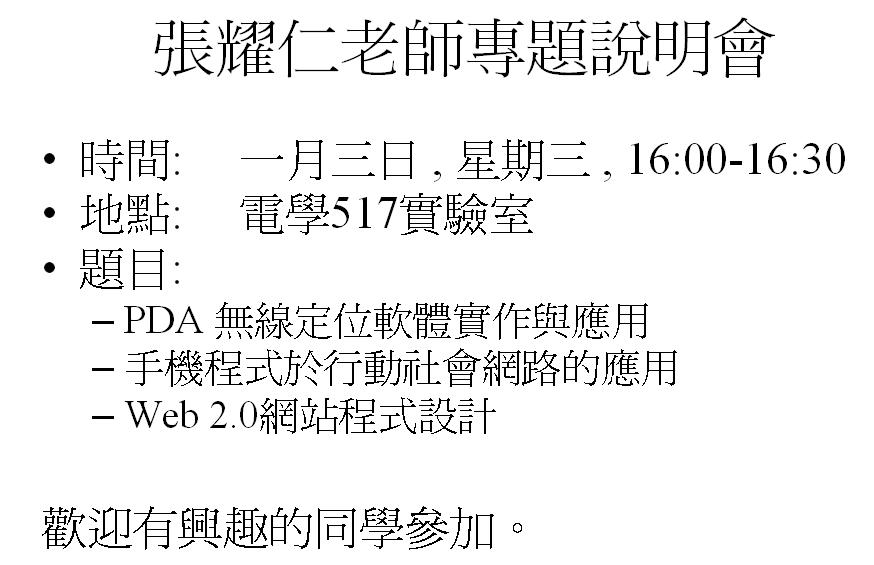
Web 2.0 無線行動系統與程式設計成長冬令營

時間: 2007130131

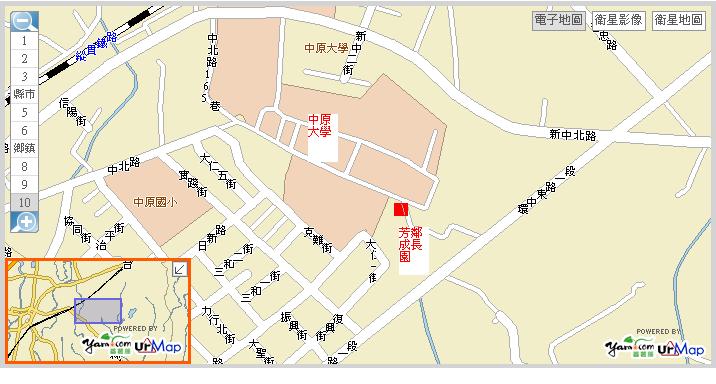
地點: 中原大學社區服務中心芳鄰成長園(位置 )

主辦: 電子系網路實驗室 (連絡電話: 4630,報名網址 http://mobilesocialtech.blogspot.com)

費用: (只接受1/26以前之網路報名)


詳細課程

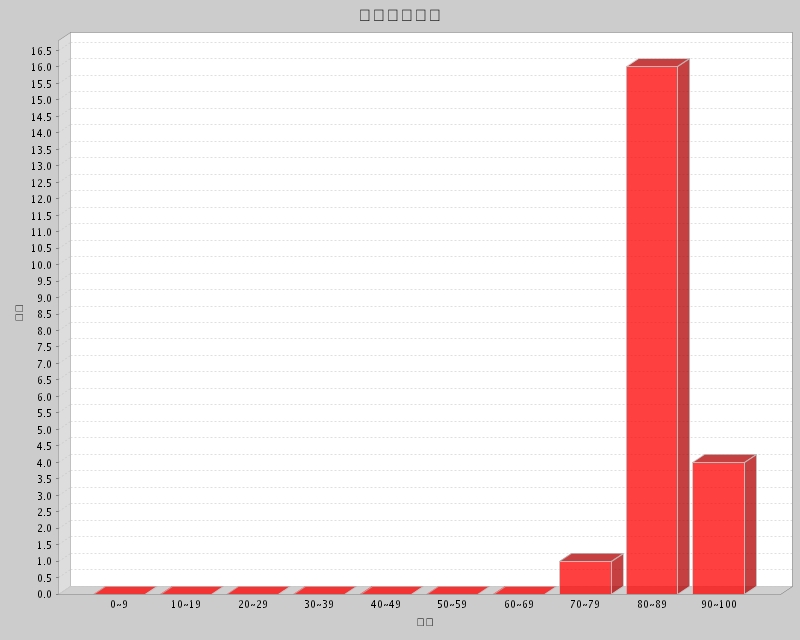
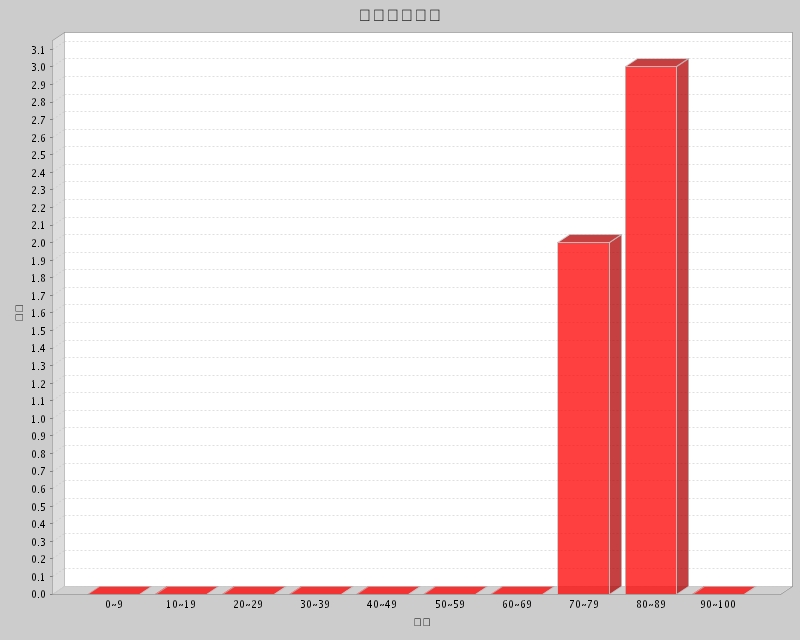
學期成績公告

研究所成績分佈


大學部成績分佈

星期三, 1月 17, 2007

Challenges faced by operators of mobile multimedia services

full text

部落格與BBS有何不同

1. Web 2.0 架構,支援 Digg, Del.ci.ous 等社會書籤。
2. 支援 RSS,不需登入網站,主動通知最新張貼。省去很多登入網站的時間。
3. 支援 Atom, 可以整個網站用 XML 完整備份。不怕網站關門或當機。
4. 結合 Google 搜尋,尋找過去資料很powerful。
5. 介面操作非常容易,初學者幾分鐘內就可以上手。(大家應該體驗過了? 因為有點年紀,學東西變慢了)
6. 支援近端comments (一般) 與遠端comments (trackback) 兩種模式。在自己的部落格也可以comment 別人的意見。比較合乎 (Berkeley) Creative Commons 的精神。
7. 可以上傳圖片。看圖說故事。
8. 可以整合 Google Docs,連結Word 與 Excel 檔案很方便。
9. 自動建立 archives,不需人員維護網站。
10. 結合人員 profiles, 方便聯繫。

星期五, 12月 22, 2006

Recent Trends

ADSL -> FTTH
  • Point-Topic:光纖降價有取代Cable modem之勢 (2006/12/14)
802.11 a/b/g -> 802.11n
3G -> HSDPA (3.5G) -> 4G, WiMax
CD -> Paid Music Download

TV-> IPTV, DTV, DVB-H
Wireline Phone -> VoIP or VoWiFi
Mobile Phone->VoIP over HSDPA

Spread Spectrum -> OFDM -> OFDM + MIMO

12-23-2006 Class

Student Presentation (schedule)

12/23
Service model: 台北市政府的VOIP公務服務系統

Web 2.0 BBS: Gaaan

Web 2.0 Personal Portal:
Wi-Fi Community Network and Business Model <fon>


預告
12/30 連假日停課ㄧ次

星期一, 12月 18, 2006

Homework 12/16/2006

For housing services, compare the three websites
http://www.housingmaps.com
http://www.urmap.com.tw/asp/kijiji/
http://www.7house.com.tw

List the differences in the user interface design and usability. Make comments
by your use experiences.

星期日, 12月 17, 2006

Web 2.0 for NPO (Nonprofit organization)

Web 2.0 is absolutely a trend that NPO should pursue.
I have a study as posted in the following.
Web 2.0 also has some problems that people start to notice. First of all, sharing is limited and diverse.
Various tools exist: Blogs, Flickr, BT, …. It is not uncommon
that one has to combine several services in order to make things done.
For example, save the documents in Google Docs, store the photos on Clickr,
and write blogs on SixApart.
Second, existing Web 2.0 service providers give limited storage and functions.
There is no roadmap about the new features people
are looking for. Change of the platform is not straightforward, either. For example,
people better not decide to move from Blogger to Xuite, because there is no import
function.
Nonetheless, I think one can still leverage the existing nice services such as Flickr, Google Docs, and Blogger that
are already popular. These services seem generic and have uses in many ways.
As to the mission critical applications that NPO want to build, Web 2.0 essentials can be built into these systems
from scratch. For example, we can do AJAX programming to make the GUI more usable and friendly.
We can also let users contribute and share their data, and even enable them to mash services up, just to name a few.
A far dream may be a Web 2.0 platform that NPO can host their mission critical applications.
In that case, all they need is learn how to use the systems without the bothering IT maintenance problems.

星期六, 12月 16, 2006

Web 2.0

Web 2.0
  • WYSWYG (What you see is what you get.)
  • Personalization
  • Mashup
  • Sharing
  • Feedback
If Web 1.0 is read only, then Web 2.0 is Read-Write.

Web 1.0 is for the user.
Web 2.0 is for the user and by the user.
Web 3.0 is for the user, by the user, and of the user.

examples:

Wikipedia

http://www.google.com/ig

Google News

Software as a Service: Wriely

Panorama Explorer

Mashup examples:
References:

What is Web 2.0? By Andy Budd of Clearleft Ltd

What Is Web 2.0 by Tim O'Reilly

星期六, 12月 09, 2006

Unlicensed Mobile Access

UMA Technology
  • seamless handoff from WiFi to cellular networks,
  • converging the fixed and mobile worlds
  • under the control and billing of the mobile operator
UMA Architecture
  • a new network element (the UMA Network Controller, UNC)
  • UNC interfaces into the core network via existing 3GPP specified A/Gb interfaces.
  • protocols for the secure transport of GSM/GPRS signalling and user plane traffic over IP.
SIP
in contrast, uses the Internet for routing

Issues
  • WLAN couldn’t really support it due to the hand-off issues among APs.
Vendors
  • Extricom selling 8 and 24-port WLAN switches
  • client on the network associates to the switch, not the radio/AP
  • No de-association or re-association
UMA in the office